Featuring Eric Gilboord
For best picture click HD on.
Video Transcript
Here are a few pointers to guide you through the initial anxiety-filled period when most new entrepreneurs are in a mental and physical transition prior to, and for a while after, the actual move. Emotions tend to be higher, and your mind is somewhat distracted by changes you are going through and the many new issues needing your attention.

1. Talk to other entrepreneurs about leaping from a job to being your own boss. You are not the first person to make this move. Others have gone before you and are usually willing to share their experiences. Lessons can be learned and costly mistakes avoided.

2. Get a basic understanding of marketing to help reduce the sense of fear, anxiety and overwhelm that occurs when you enter an area of unfamiliarity. Read books on marketing and take marketing courses. Become familiar with marketing terminology and activities.

3. Take advantage of up front time before you leap.  Start the thinking process early, before you jump. Waiting until you leave to start your planning can be too late. Do as much advance work as possible. Research your target group, competition, the potential of your idea, and the services you'll offer. Start the marketing process by working to determine who you are and what you are selling.

4. Ask yourself if your expectations are realistic? Discuss these issues with your family and get their agreement. A reasonable initial financial goal should be to at least replace your current income. Be prepared as this goal may take longer to reach than expected.

5. Consider approaching your present employer and offer your services on a contract basis. They could be your first customer, serving as a stepping stone until you develop a larger customer base.

6.  Go out and see prospects. Be objective, honest, realistic, about what you can do, who you are, don't over promise. I recommend making your early mistakes with smaller less important potential customers.  Don't take it personally if you are rejected. They may be reacting to the way you have presented your company or they may genuinely not have a need for your services. Either way there is valuable learning to be had.

7. Qualify leads carefully, hear what a prospect is saying not what you want them to say and be very realistic about their intentions. Many promising businesses have failed in infancy because a new entrepreneur thought a positive response to their idea meant money in the 


Here's 7 more.

8.  Join up with other small businesses who complement your products or services. They could provide much needed leads and act as part of your support system.

9.  Look for a mentor or group of advisors to provide guidance. Preferably those familiar with the business you are entering. They may have been there before you and hopefully can help to avoid some of the pitfalls of running your own business.

10. If you are planning on a career change try working for a company in the same business you are entering learning what and what not to do.

11. Make sure your voicemail is businesslike and professional before you leave the job, while going through the initial research stages. It is not necessary to use a company name, but leave a professional message and don't have the kids answering the telephone. Train them early, when to answer and what to say or get an extra telephone line for your computer (internet/fax) and business voicemail.

12. Purchase computer equipment early and learn to use it. You don't want to be scrambling at the last minute learning new software when you're trying to produce a letter or proposal.

13. Prepare marketing tools with the understanding that you will likely need to revise them as you go. Get business cards and letterhead produced in small quantities. Do not produce homemade cards. The negative message you are sending out is a lack of commitment to the idea you are attempting to base a business on.

14. Have fun but don't let the new business venture consume your life. Make time for family and friends. You will be amazed at how much more energy and clarity you will have if a balance is maintained.
Click for help.
Looking for help?
 
 
Picture
Click article to enlarge.


Featuring Eric Gilboord
For best picture click HD on.
Video Transcript

1. Build Traffic At Point Of Sale. This could be at your store or office or a trade/consumer show.

2. Promote Trial Use of Products During Launch Phase. If you have a new product or service, you will need to create some excitement and to generate special interest in it.

3. Counter Competitors' Tactics. Your competitor just started a new advertising campaign and customers are drawn to their special offer. You need to fight back and regain the attention of your customers.

4. Level Seasonal Sales Peaks and Valleys. Sales may seem to be on a roller coaster ride sometimes and you need to have more control over cash flow and inventory management.

5. Control Overstock Situations. The brand-new widget you imported is turning out to be a dud and you can't afford to carry it indefinitely. It's time for a blowout sale.

6. Gain Leverage And Stretch Your Advertising Budget. Use cooperative programs with other marketers whose products or services are complementary to your own (e.g., software and computers, swimming pools and water treatment supplies).

7. Complement Your Regular Advertising Program. Promotions add a new dimension as part of a multi-disciplined strategy.

8. Develop Your Customer And Prospect Databases. Not every business requires customers to supply contact information. A quick way to gather names of existing customers and prospects is to run a promotion and get them to fill out a ballot online or in person.


Picture
It's been an interesting few months for me, filled with both personal and professional victories. I have to believe that in some small way this was due to living the advice and direction I provide in my blog and 'preach' to business associates and friends.

Recently I was fortunate to meet some new clients who when faced with overwhelming challenges have chosen to NOT GIVE UP. Just by making this fundamental decision they are already seeing success. Small wins and light at the end of the tunnel are the first indicators you have chosen the right path. Now is when you lean into it and give 150%. This weeks post is about commitment.  Eric Gilboord, A2E


9 Things to Think About Before You Give Up
by MarcandAngel.com

If you feel like you’re at the end the road with nowhere to go, realize you are lying to yourself.  You have imprisoned yourself in your own mind by telling self-defeating stories – stories about what your life should be like, what you should have already accomplished, and so forth.  By doing this you’ve created a tiny space in your mind and you’ve begun to believe you are actually living in it.

But you are NOT.  You are alive in a vast world with infinite destinations.  Take a moment to remind yourself of this.  Go outside.  Look at the sky and the clouds.  THIS is the space in which you really live.  Breathe it in.  Then look at your current situation again.

Here are some things you need to consider before you give up:
  1. You never fail until you’re satisfied with failure. – Failure is not falling down; failure is staying down when you have the choice to get back up.  Sometimes you have to fail a thousand times to succeed.  Which means you haven’t really failed yet; you’ve just found a bunch of ways that don’t work.  So don’t get so hung up on a few failed attempts that you miss every new opportunity coming your way.  All of your ideas that don’t work are simply stepping stones on your way to the one idea that does.  As Winston Churchill once said, “Success is not final, failure is not fatal: it is the courage to continue that counts.”  Read Awaken the Giant Within.
  2. What you have learned is what’s important. – Life always offers you a second chance – it’s called tomorrow.  But this second chance doesn’t mean anything if you haven’t learned from the events of today.  You have to acknowledge your troubles but gather strength from them, and laugh at your mistakes but learn from them.  Getting a second chance in life is about giving yourself the opportunity to grow beyond your past failures.  It’s about learning as you go and positively adjusting your attitude and efforts toward future possibilities.
  3. Tough times are just part of life’s natural balance. – Life lives, life dies.  Life laughs, life cries.  Life gives up and life tries.  And life looks different through everyone’s eyes.  In fact, who you were, who you are, and who you will become are three completely different people.  And as you gradually grow beyond the person you were yesterday, keep life’s challenges in perspective.  Hear life’s harmony, and notice the delicate balance.  Realize that life is like playing a grand piano.  The white keys create your happiness and the black keys denote your troubles.  But as you go through life’s journey, remember that the black keys also create music.
  4. Pain helps you grow. – Sometimes things must change so you can change.  Sometimes you must break a little so you can get a peek inside to see what an awesome powerhouse you are.  Sometimes mistakes must be made so wisdom can be earned.  Sometimes you must overcome heartache so you can begin to follow your heart again.
  5. Success is a way of living. – Don’t let your struggles become your identity.  Not everything in your life will go as you expect it to.  This is why you need to drop expectations, live in the present, and go with the flow, rather than against it.  Remind yourself that it’s perfectly okay not to be perfect.  Ultimately, success is not something you achieve, it is what you learn and how you grow as you deal with the realities of life – it is a way of living and being.  Read As a Man Thinketh.
  6. You can choose differently. – The difference between a mountain and a molehill is your perspective.  And in many cases, the only thing in life you have control over is your perspective.  No matter what happens, YOU control what the meaning is, and what to do with the meaning you give to the circumstance.  Choose to react in a way that motivates happiness, love, or forgiveness, even when circumstances make that choice difficult.
  7. It’s not supposed to be easy. – Just because you’re not where you want to be today doesn’t mean you won’t be there someday.  Again, success is tied to long-term determination.  Successful people keep moving and trying.  They make mistakes, but they do not quit.  If things in your life aren’t happening as planned right now, that’s okay.  It just means it’s not the right time.  Life’s brick walls are not there to keep you out, they’re there to give you a chance to show how badly you want something.  They’re there to stop the people who don’t want it as bad as you do.
  8. Simplify, simplify, simplify. – Like all magnificent things, life is quite simple.  Its simplicity is found not in seeing how little you can get by with – that’s poverty – but how efficiently you can conquer your biggest difficulties.  Remember, the greatest wisdom of life consists in the elimination of non-essentials.  Your most significant ideas and accomplishments will be genius in their simplicity.  One day you will find the right words, the right decisions, and the right solutions that will lead you to victory, and they will be far simpler than they seem right now.  Read The Power of Less.
  9. Life is still good. – You may have seen better days, but you have also seen worse.  You might not have all your wants, but you do have all your needs.  You woke up with a few aches and pains, but you woke up.  Your life may not be perfect, but it is good.  And more good things are coming down the road as long as you keep moving forward.
If you would like some assistance to move forward Contact WarrenBDC.


Featuring Eric Gilboord
For best picture click HD on.
Video Transcript
Does your daily battle with your competition resemble a David and Goliath fight, with you being the David in the story? Our marketing guru Eric Gilboord says it doesn't need to seem that way and has 7 sure fire ways to beat large business competitors.

1. Outmanoeuvre Them. A small business is like a speedboat that can manoeuvre quickly, slow down or speed up as needed, and turn around completely in a much smaller space than a battleship (a larger business) can. A new strategy may take a large business three months to develop and implement. You could execute it in three days.

2. Offer Genuine Personal Attention. Small businesses can offer real personal attention, greeting customers by name and having a brief conversation with them when they enter their establishments. Customer service is more than screaming, ''Hello!'' indiscriminately when someone walks into a store. I find this particular activity, conducted mostly by the larger U.S.- based chain stores, to be somewhat unsettling and in many cases, quite insincere.

3. Choose Between Help And Help Yourself. I prefer to buy from small businesses because they're usually more ready, willing, and able to help me. It seems that customers must choose between getting help and helping themselves. The staffs at some larger organizations tend to be busy stocking shelves. They may point out where something is but they don't always have the time or the expertise to help customers make a purchase.

4. Educate Yourself. Education can be an important part of the purchasing process. When many products deliver the same benefits, it is not always easy to make the right choice. In order to select the best product or service for your needs, you may require education. Small businesses tend to be better suited at offering assistance and are the best choice for one-time requests or requests for unusual or rare products and services.

5. Tailor Your Products. A small business has the ability to tailor its product or service selection to its specific customers. The most popular products your specific customer desires can be stocked in depth. This feature can be a disadvantage to large businesses as they carry a wide range of products offering little choice within a specific product group. Don't forget to promote this advantage. Your business may represent one section of one aisle in a big box store. You don't need to worry about the rest as you are not in those businesses.

6. Train Your Staff. Make sure you don't make the same mistakes that some large businesses make. Don't fall into the trap of being too busy to provide good service. Unfortunately, several large businesses seem to have staff to stock shelves but not to help customers and in some cases, not even to take your money. I can't imagine any small business allowing a customer to stand in the middle of the floor with his or her money and no one to give it to.

This unfortunate experience happened to me in one of the well-established department stores. I couldn't even pay for the one item that I came in to buy. But small businesses don't always have good service. You must train your staff. 

Your larger competitors probably have training programs. Your advantage is the ability to have an informal, on the spot training session for your staff. Augment any formal group training with small amounts of input when needed. If you notice something wrong or there's a situation where you can improve your service, the changes can be made almost immediately, unlike your larger competitors, who may have to take months to develop a more formal, structured training program.

7. Don't Compete On Price Alone. Some small businesses charge a little more than a larger competitor but that's OK. Some segments of your target group are willing to pay a little more in order to receive better service. It's up to you to provide it and to make sure that customers know they are receiving added value. Some customers will always look for the lowest price. They will shop around, use your time and expertise, then go to your larger competitors to make the purchase. 

It's your job to recognize these people and to educate them about the advantages of doing business with you. Customers are not mind readers. These ideas apply to many business categories such as retail, manufacturing, and industrial or professional services. No matter what business you are in, act like a speedboat and outmanoeuvre the battleship. Go out and run circles around big businesses.


Picture
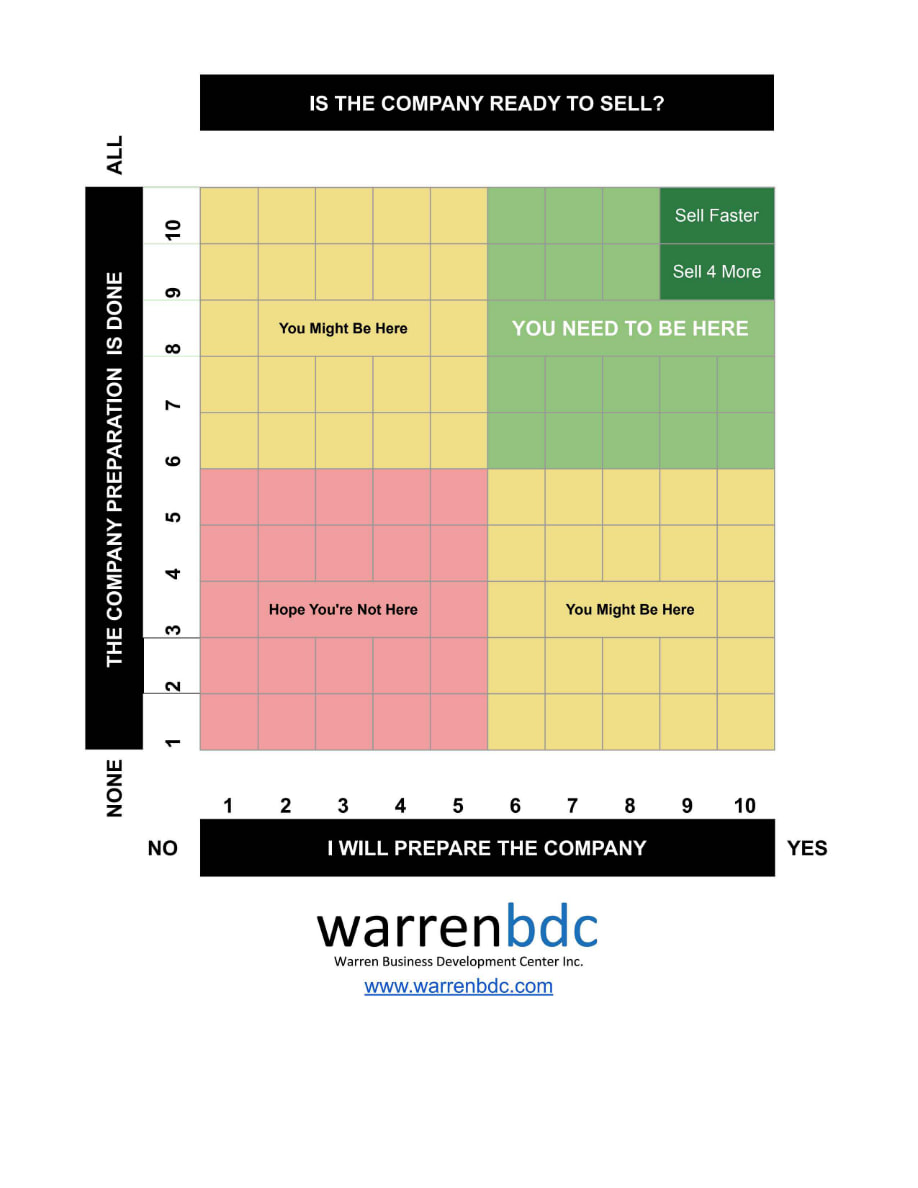
It seems that much of the advice, government programs and general interest with small business is about start-ups. But what about Owners of established businesses getting ready to Start-Down. Ready to SELL their business and move on to the next exciting challenge in their life. Remember, 60 is the new 40 and you have many new adventures ahead of you.

Often we find boomer age business owners lack the team to SELL their business successfully. To better assist my Clients and Prospects I'm organizing a Silver Mastermind Group - specifically for owners of established businesses thinking about or already at some stage in the process of selling their company.

If you're interested contact me directly at eric@warrenbdc.com

This week's email is on Start-Down the Opposite of Start-Up 

Go on give it a read you have everything to gain. As well, you might like to pass this post along to someone you know who fits the Start-Down profile. A2E

Thank you, 
Eric Gilboord, CEO 
Warren Business Development Center Inc.
416-270-2466
Bonus Posts
Sell Or Don't Sell -The New Retirement Question
Reap The Best of Both Generations
7 Essentials to Sell Your Company at a Premium


Picture
Looking At Your Customers, Through An Angel Investors’ Eyes
by Eric Gilboord

Angel Investors often invest money and time. As a business owner you’re investing your time, resources and money in acquiring or keeping customers. The wrong customer can be costly and disruptive to your company. Your customer base is like an investors’ portfolio. Smart Angels review their investments to adjust for performance and economic changes. Wise business owners do the same with their customer base.

Typically 20% of the customers contribute 80% of your income. An experienced Angel may invest in 10 companies hoping to score a hit with one or two. It may be time to review your customer list and fire the bottom 10% as an investor might do while cutting their losing investments. Then focus your resources on finding better customers with larger opportunities. Or simply spend more time on some of the good customers you already have.

Finding good customers and keeping them is hard enough without spending a disproportionate amount of your time and resources on generating more new ones. Before you accept a new customer, consider using the indicators below to determine whether or not they are a good fit for your company. Various criteria may be utilized. Here are 7 to get you started.

7 Things to Consider About Current or New Customers
  1. Do they have the ability to pay for your services? 
  2. Have they used a service like yours before and was it successful? What went wrong?
  3. Are their sales up or down? Do you want to be part of a winning or losing situation? 
  4. Are their employees happy or biding their time waiting for the doors to close?
  5. What is their reputation with customers and competitors? Are they forward thinking or out of pace with their industry?
  6. Do they have a plan to grow? This includes Business, Sales and Marketing plans. 
  7. Do they have complete management and worker teams or are there holes? Is that trouble or an opportunity for you as a supplier?
 
 
Featuring Eric Gilboord
For best picture click HD on.
Video Transcript
Marketing goes well beyond advertising, website and brochures. It also includes many intangible ideas the small business owner/operator needs to understand, observe, and respond to, including the following:

1. Customers' Needs. A clear understanding of your customers' needs and a strong commitment to satisfy them should be at the heart of your marketing program. You do not have a business without customers. The survival and growth of your business will come from providing great customer service. Happy customers will be loyal and bring you new customers.

2. Competition. Many businesses are aware of their competitors but do not possess intimate knowledge of them. If you know what things they are doing right and what things they may be doing wrong, you can learn from their experiences and apply the good to your organization and avoid the bad. Understanding your competitors will often give you the opportunity to anticipate how they may respond to your tactics. You can then anticipate their marketing activities and be prepared.

3. True Value Of An Opportunity. Look under the surface. Not every opportunity is as it may seem. You need a strategy to assess new opportunities and to allow yourself the choice to walk away from what could be a damaging experience to your company. If it looks too good to be true, it probably is.

4. Times Are Changing. This is a time of rapid and constant change. Traditional ways of thinking will either produce traditional results or prove to be fatal in this non-traditional business climate.

5. Get Progressive. Think about your marketing in an aggressive manner. Break away from the old reliable ways and begin new traditions. If you apply new thinking to new problems and new opportunities, you will see new results. New traditions will have much shorter life spans and will be quickly replaced by more new ideas. Thinking about your business is much like hitting a moving target.

6. Know What You Don't Know.
The awareness that there are many things you do not know is also important to the constant updating of information on customers, competitors, and the industry you are in. A wise business owner knows what he or she doesn't know, employs a strategy, and finds the answers.

7. Develop New Business. Business owners would like to believe that customers will just come to them, but this is not the reality. New business development is just as important to a marketing program as satisfying existing customers. If you wish to grow your business or even to keep it at a certain level (customers can leave for various reasons and you often do not have control over their decisions), you will need new customers. You will require a formal, well-thought-out new business development strategy.

8. Customer Contact. In order to meet the sometimes enormous challenge of monitoring and interacting with large numbers of customers and new prospects, you will need a contact management strategy. How you keep in touch with customers and the ease with which you or your staff are able to reach them will dramatically affect the level of customer service you can offer.

"Demonstrate, you know your business and a clear understanding of their needs." A2E


Allies and Acquaintances: Two Key Types of Professional Relationships
By Reid Hoffman (The man behind LinkedIn)

Professional Allies: People Who Have Your Back.
What makes someone an ally in your job and career? First, it's someone you consult regularly for advice. You trust his or her judgment. Second, you proactively share and collaborate on opportunities together. You keep your antennae especially attuned to an ally’s interests, and when it makes sense to pursue something jointly, you do so. Third, you talk up an ally to other friends. You promote his or her brand. When an ally comes into conflict, you defend him, and stand up for his reputation. And he does the same for you when times get tough. Finally, you are explicit about your bond. You might say to each other, “Hey, we’re allies, right? How can we best help each other?”